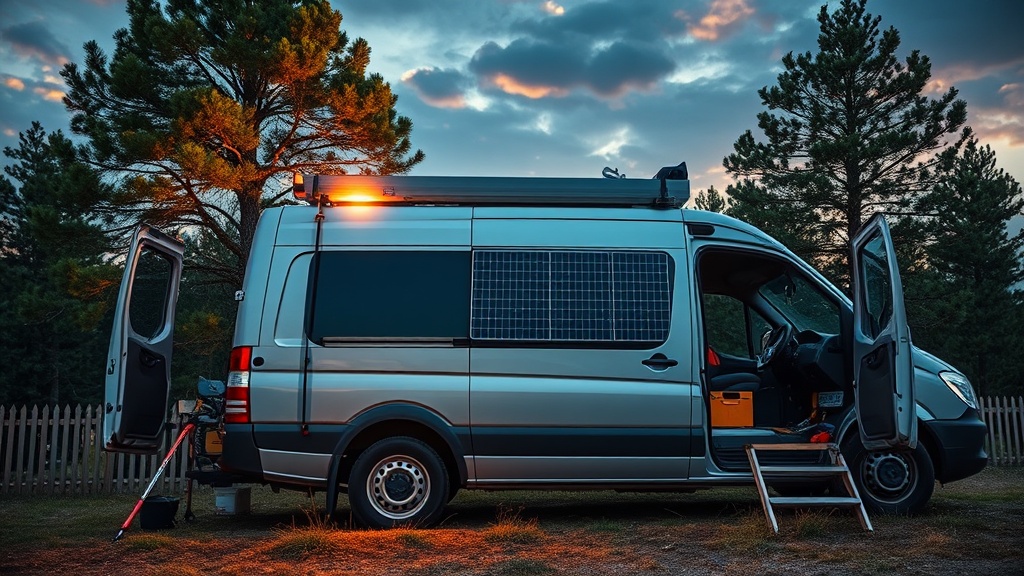
Setting Up a Reliable Solar Power System for Your Van

Most people think buying the biggest solar panel you can find is the secret to endless power in a van. It isn't. A massive panel won't help you if your battery can't store the charge or if your components are mismatched. This guide breaks down the actual mechanics of building a reliable solar setup, focusing on the math and the hardware you actually need to keep your fridge running and your lights on while off-grid.
How Much Solar Power Does a Van Really Need?
A typical van build requires between 100 and 400 watts of solar depending on your electrical-hungry appliances. If you only run a phone and a couple of LED lights, a small 100W panel might suffice. However, if you're running a Dometic compressor fridge or a laptop, you'll need a much more substantial array.
Don't just guess your needs. Calculate your daily consumption first. Look at the wattage of every device you plan to use. A single 12V fridge can pull a surprising amount of energy over a 24-hour period. If you don't account for the "vampire draw"—those tiny amounts of power things use even when they're "off"—you'll find yourself staring at a dead battery by 2 AM.
Here is a quick way to categorize your power needs:
- Low Demand: LED lights, phone charging, small fan (100W - 150W solar).
- Medium Demand: Laptop use, small blender, medium fridge (200W - 300W solar).
- High Demand: Induction cooktops, heavy-duty coffee makers, multiple high-draw devices (400W+ solar).
Keep in mind that solar output isn't a constant. You might get 100% efficiency in the high noon sun of Arizona, but in the Pacific Northwest, you'll likely see a fraction of that. Always over-spec your panels slightly to account for cloudy days and seasonal changes.
What Components Do I Need to Build a Solar System?
You need four main components: solar panels, a charge controller, a battery, and an inverter.
The solar panels are the source of your energy. You can choose between rigid panels, which are durable and efficient, or flexible panels, which are lighter and easier to mount on curved roofs. Most van dwellers prefer rigid panels because they handle the vibrations of road travel much better.
The charge controller is the "brain" of the system. It sits between your panels and your battery, ensuring you don't fry your electronics with too much voltage. You have two main choices here: PWM or MPPT.
- PWM (Pulse Width Modulation): These are cheaper and simpler, but they are much less efficient. They basically "clip" the voltage to match the battery.
- MPPT (Maximum Power Point Tracking): These are the gold standard. They track the voltage and current to extract the maximum power from the panels. If you're serious about off-grid living, don't settle for anything less than an MPPT controller.
The battery is where the energy lives while you aren't using it. While many people still use Lead Acid or AGM batteries, Lithium Iron Phosphate (LiFePO4) is the industry standard for a reason. Lithium batteries are lighter, last longer, and can be discharged much more deeply without damage. Brands like Victron Energy offer high-quality components that work seamlessly together.
Finally, the inverter converts the DC power from your batteries into AC power for standard wall plugs. If you want to plug in a laptop or a small blender, you'll need an inverter. Just remember: inverters are rarely 100% efficient. You'll lose a little bit of power just through the process of converting it.
Comparing Battery Types
| Feature | AGM (Lead Acid) | LiFePO4 (Lithium) |
|---|---|---|
| Usable Capacity | ~50% | ~90-100% |
| Lifespan (Cycles) | 300-500 | 2000-5000+ |
| Weight | Heavy | Light |
| Cost | Low | High |
How Do I Size My Battery Bank Correctly?
To size your battery bank, multiply your total daily watt-hour consumption by two to ensure you have enough buffer for cloudy days. This is a safety margin, not a suggestion. If you use 500Wh of energy a day, you want a system that can comfortably hold at least 1000Wh of capacity.
It's a common mistake to look only at Amp-hours (Ah) and forget about Voltage. A 100Ah battery at 12V is 1,200 Watt-hours. A 100Ah battery at 24V is 2,400 Watt-hours. Always do the math to convert everything to Watt-hours (Wh) before you start buying gear. It makes comparing different products much easier.
If you're building a system that's going to be your primary source of power during a long winter trip, you'll need to be even more conservative. Cold temperatures actually slow down the chemical reactions in batteries (even lithium), so your capacity might feel lower than it does in the summer. It's better to have too much power than to end up stuck in the middle of nowhere with a dead fridge and no way to charge your phone.
One thing to watch out for is the "depth of discharge." With an AGM battery, if you drain it to 0%, you've essentially killed it. With Lithium, you can go much lower, but you still shouldn't make a habit of it. It's a fine line between being efficient and being reckless with your gear.
When you're planning your layout, think about the physical space. Lithium batteries are compact, but you still need to account for the wiring and the mounting brackets. Don't forget that wires have resistance too. If your wires are too thin or too long, you'll lose power to heat before it ever reaches your appliances. Using thicker-gauge wire is a small investment that pays off in reliability.
When you're out on the road, especially during a long trip through the mountains, your power needs might change. If you find yourself needing more warmth or better light, you might need to adjust your setup. For instance, if you're planning a trip through colder climates, you'll want to ensure your power management is top-notch. You might even want to check out tips for keeping your coffee hot in cold weather to ensure your morning routine isn't interrupted by a low battery.
Building a solar system is a bit of a learning curve. You'll likely make a mistake or two during your first build—maybe a fuse blows or a wire is slightly too short—but once you get the hang of the math, it becomes a very predictable science. Just take it one component at a time.
Steps
- 1
Calculate Your Power Needs
- 2
Select Your Solar Panels and Charge Controller
- 3
Install the Battery Bank and Inverter
- 4
Wire the System and Test for Voltage